
A Glimpse into Global Health Night 2026: Putting People First
By Val Muñoz
Credits: Sofia Santos Nunes
On November 12, 2026, McGill Global Health Programs hosted the 18th Annual Global Health Night, bringing students, faculty, researchers, partners, and the broader McGill community to celebrate student accomplishments and shared commitments in global health. With over 200 attendees, it is one of the most highly anticipated events of the year.
Spotlighting Student Research and Collaboration
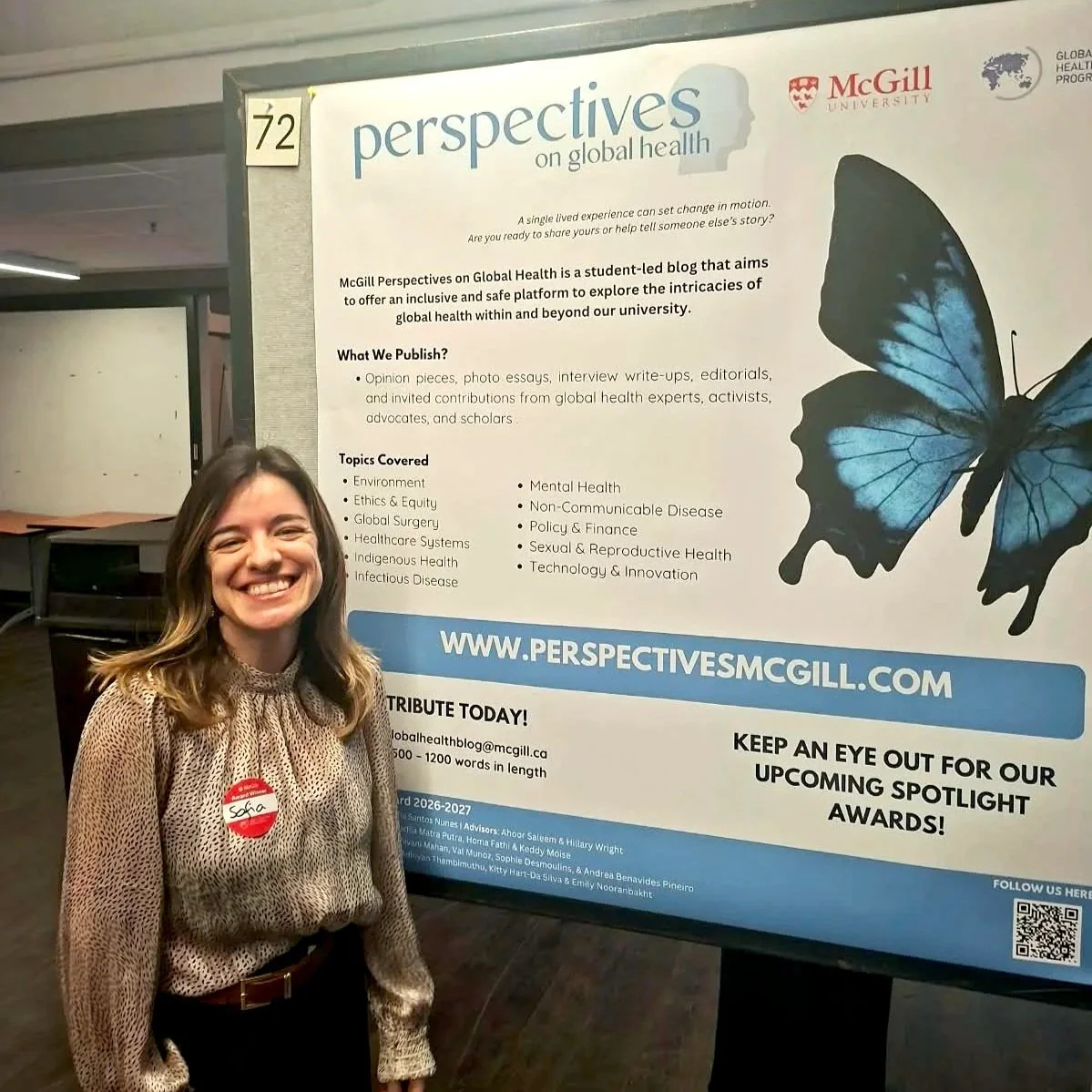
The event began with a poster fair featuring more than 80 different research projects and initiatives. Topics ranged from infectious diseases, environmental health, Indigenous health, and noncommunicable diseases. Undergraduate, graduate, medical, dental, and post-doctoral students presented work reflecting the diversity of approaches needed to address global health challenges.
Credits: Sofia Santos Nunes
There is a place for everyone in Global Health. The interdisciplinary nature of the evening highlighted that addressing complex challenges requires different forms of knowledge and an openness to learn from one another.
When Val Muñoz, health reporter at Perspectives, asked attendees: “What significance do events like Global Health Night mean to you?” , their responses reflected this sense of community.
“Events like Global Health Night are a way to really spotlight the different research efforts, knowledge mobilization efforts, and knowledge translation efforts that various different members of the student community are involved with,” said Rayyan Mounib, a 2026 Global Health Scholar studying International Development. “I think that events like Global Health Night bring me a lot of hope."
For Bella-Mai McNulty, a 2026 Global Health Scholar studying Sustainability, Science, and Society, the value lies in exchanging ideas across disciplines:
“I'm seeing that everybody has these different ways of knowing and different ways of conveying their different knowledge systems […] being so interdisciplinary, being able to communicate with people from all these different fields and these different degree backgrounds and career backgrounds, and pooling and sharing our ideas together."
These encounters also provide opportunities to bring attention to health inequities that remain overlooked.
“A lot of people don't know that tuberculosis is an issue in Canada, and it's one of Canada's greatest inequities that Inuit people experience TB while a lot of non-Inuit, non-Indigenous people do not.” explained Abeera Ibfran, MScPH Candidate at McGill University and a 2025 McCall McBain Scholar.
People’s Health in People’s Hands
The second half of the evening opened with remarks from McGill leadership, recognizing the university's growing engagement in global health. Dr. Madhukar Pai, Chair of the Department of Global and Public Health, highlighted several accomplishments, including the inaugural cohort of the Bachelor of Arts in Population and Global Health, the Nkabom Collaborative's partnerships in Ghana, and the continued expansion of the Summer Institutes in Global Health. The evening also recognized the lifetime contributions of Professors Greg Matlashewski and Theresa Gyorkos to global health research.
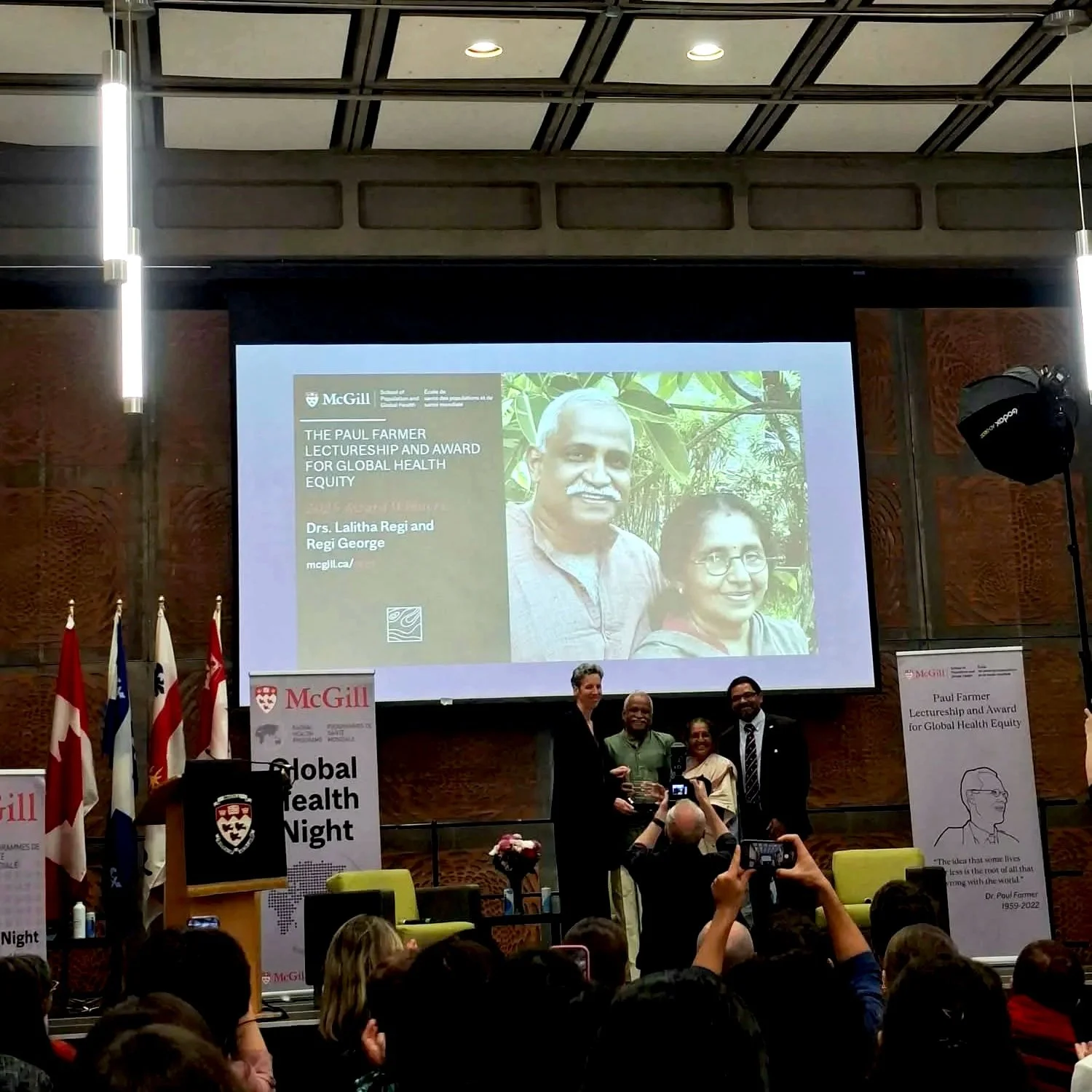
One of the evening's most anticipated moments was the Paul Farmer Lecture in Global Health Equity, delivered by Drs. Lalitha Regi and Regi George, co-founders of the Tribal Health Initiative in Sittilingi Valley, Tamil Nadu, India, and co-recipients of the 2025 Paul Farmer Award for Global Health Equity.
Their lecture, titled "People's Health in People's Hands", offered a compelling reflection on more than three decades of living and working alongside tribal communities in rural India.
Their story began in 1993, when access to health care was extremely limited. The nearest doctor was about 50 kilometres away. In the beginning, their first hospital was a small hut built with the community, where medical procedures were performed under solar lighting.
But the most significant changes did not come from the hospital alone.
Local women were trained as health workers, community members became actively involved in health education, and residents increasingly took leadership in decisions affecting their lives. What began as an effort to improve access to medical care expanded into agricultural cooperatives, women's collectives, traditional crafts, water management, and local governance.
The physicians shared impressive improvements in health outcomes, including a reduction in infant mortality from 147 to approximately seven deaths per 1,000 births over the course of their work. They attributed this progress to the community's growing capacity to organize and act.
"Health is made outside the hospital," they argued.
Food security, income, dignity, education, and political participation are not separate from health.
Their reflections echoed an earlier Perspectives on Global Health interview conducted by Sofia Santos Nunes, "Health Begins with Listening," in which the physicians discussed how listening to communities transformed their understanding of health and challenged conventional assumptions about professional expertise.
At Global Health Night, they reinforced this message through a particularly important lesson for students and future health professionals:
“It is also necessary that young doctors and health professionals learn that walking the path is more important than reading textbooks. Credibility comes from staying, not from the quality of any single intervention. Being there with the people in both happiness and disaster. Sharing their joys and their sorrows is much more important “than fancy programs and high input projects."
Their message questioned the tendency to measure success primarily through the number of interventions implemented or communities reached. During the discussion moderated by Dr. Srividya Iyer, the physicians challenged the assumption that successful community programs must always be scaled up. Instead, they described choosing to deepen their work within the same communities rather than expanding into additional villages.
The lesson was not that every community should reproduce the Sittilingi model, but that communities should have the authority to define their own priorities.
Their experience offered a kind reminder that trust takes time. Meaningful participation requires shared decision-making, and lasting change depends on relationships and the collective.
A shared responsibility for the future of global health
The evening concluded with the announcement of the 2026 Paul Farmer Award co-recipients, Professor Najla Al-Sonboli and Dr. Nasher Al-Aghbari of Yemen, recognized for their longstanding commitment to providing pediatric care and strengthening health services amid conflict.
Across the poster presentations and keynote lecture, a common message emerged: global health is fundamentally about people and recognizing that communities are essential partners and leaders in shaping transformation.
Global Health Night reminded us of the responsibility that comes with working in global health: to listen before acting, to build relationships rather than simply implementing projects, and, fundamentally, to place people's knowledge and priorities at the centre of everything we do.
Watch the recording of the full event here: 18th Annual McGill Global Health Night & Paul Farmer Lecture for Global Health Equity
Val Muñoz
is a queer, Latinx, first-generation university graduate passionate about the intersections of environment, public health, and education. They hold a BA in Environment with a concentration in Ecological Determinants of Health and an MA in Educational Leadership both from McGill University, aspiring to become a professor.