
Health Begins with Listening: An Interview With Paul Farmer Award Holders 2025 Drs. Lalitha Regi and Regi George
By Sofia Santos Nunes
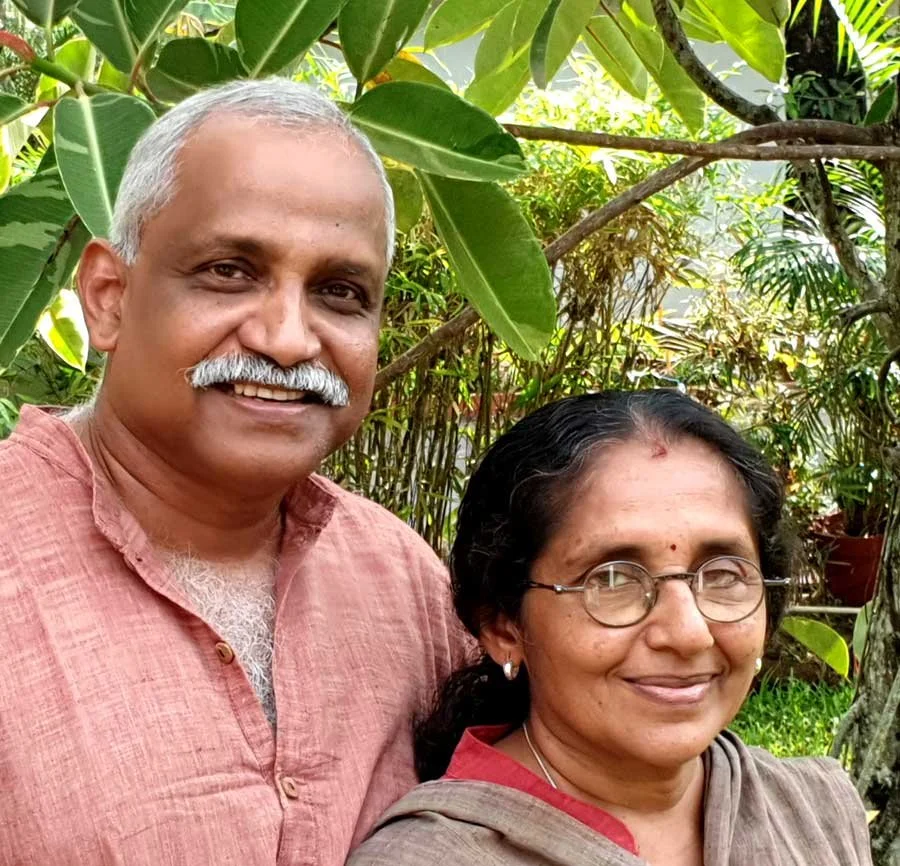
More than three decades ago, Dr. Lalitha Regi and Dr. Regi George arrived in a rural community named Sittilingi Valley in Tamil Nadu, India, where high infant and maternal mortality and severely limited access to medical care. They began, as doctors often do, by building a hospital. But the transformation that followed would ultimately reach far beyond medicine.
The Tribal Health Initiative
Looking back on more than 30 years of work, the physicians behind the Tribal Health Initiative - a public charitable trust that runs a hospital and coordinates programmes in community health, farming and craft work - describe a lesson that appears deceptively simple: health cannot be transformed by professionals alone. The most important changes, they argue, happened because community members themselves became the health workers, decision-makers and leaders of that transformation.
“The main reason why it is possible [is] because it was done by the people,” explains Dr. Lalitha during an interview with McGill Perspectives on Global Health.
Young women from the community were trained as health workers and nurses. Many had never attended school and were farmers themselves. They played a key role because some longstanding practices surrounding childbirth, for example, could not simply be changed through instructions from doctors. Community members had to collectively examine which traditions remained valuable and which were harmful. Their involvement made it possible to question practices that outsiders alone would have struggled to change.
Their experience offers a challenge to one of global health’s most persistent assumptions: that expertise travels from institutions to communities. Here, knowledge moved in both directions!
When health moves beyond the hospital
From the beginning, the doctors understood that clinical services alone could not address everything affecting health. Health is inseparable from social, economic and political conditions. What they did not know was where that understanding would eventually lead them.
After approximately a decade concentrating largely on maternal and infant mortality, they faced the question: what should come next?
Instead of deciding themselves, they walked from village to village in a “padayatra” meeting residents across 25 villages. They stayed with people, listened, and asked what communities needed.
The answer was not another medical intervention: people wanted help with agriculture!
The doctors knew little about farming, so they sought guidance from organizations and farmers working in organic agriculture. Changes in farming subsequently influenced food availability and nutrition, including greater access to traditional grains such as millets. According to the couple, these changes had a positive impact not only on health and nutrition but also on household income stability.
“We came to the conclusion that we know nothing, the community knows a lot of things. We are here to help them. Many times, the community gives you the answer but then it is up to you to just start implementing it.” Dr. George reflected. Their role became less about arriving with predefined solutions and more about using the skills and resources they possessed to help communities implement their own priorities.
Women transforming the health system
The transformation was also deeply gendered. When the initiative began, women in the community had few professional options outside agriculture and household responsibilities. Families initially struggled to understand why young women would be trained for healthcare roles.
Over time, however, the first generation of health workers became role models. Younger women pursued training in nursing and other healthcare occupations, while others moved into entirely different professions, including engineering.
Social attitudes toward women, they stressed, still need to change considerably. Yet the difference between the opportunities available to women three decades ago and those available today is substantial.
That evolution eventually extended into local governance. Tired of traditional parties, the villagers decided that they would choose someone connected to Tribal Health Initiate. They selected Ms. Madheswari Manjunathan, a senior nurse at the hospital, who became president of the local “panchayat” in 2019. During her five-year term, government resources were mobilized for roads, electricity, running water, schools and childcare services across villages.The experience revealed that governance itself can function as a health intervention.
Doctors cannot build roads or provide water infrastructure, they noted, but local governments can and those decisions directly influence health.
Before intervening, accept what you do not know
Perhaps the interview’s most consequential message was directed toward students and young professionals entering global health. Before earning the right to intervene, they argued, professionals must first recognize what their formal education has not taught them.
A degree can provide important knowledge, but it cannot teach professionals everything about how communities experience illness, healthcare systems or everyday life. For these physicians, living alongside the community exposed the limitations of their own education.
“You have to understand your ignorance and accept it,” Dr. Lalitha said.
This also means reconsidering short-term, project-based models of global health. Interventions designed elsewhere may produce short-term results, but their effects can fade once funding ends or external professionals leave.
Their alternative is slower: live with communities, build trust, listen and create relationships in which professional and community knowledge are treated as complementary rather than hierarchical.
New challenges
Success has not eliminated new health challenges. The physicians described growing concerns around mental health conditions, substance use, suicide attempts and intergenerational conflict. Economic and technological change has transformed village life rapidly. Younger people increasingly leave to study and encounter different worlds before returning home, sometimes creating sharp differences between generations.
At the same time, traditional forms of social support have weakened. Families once spent more time together, talking across generations. Television, mobile phones and internet connectivity have altered those interactions. The result, they suggested, is an increasingly individualized community despite having historically relied heavily on collective life.
The next project is determined by the community.
Receiving the Paul Farmer Award for Global Health carries particular meaning for the team because Farmer’s approach to public health, together with Gandhi, has long influenced their own thinking.
When asked about the Tribal Health Initiative’s next project, they left the answer to the community. They will continue their current health and agricultural work until people identify another priority and ask whether the initiative can help address it.
At the end of the interview, the physicians returned to the words of the ancient Chinese philosopher Lao Tzu: “Go to the people. Live with them. Learn from them. Love them. Start with what they know. Build with what they have.”
For future global health professionals, their own addition may be equally important: lead from behind and listen to the people. Because “if you involve the people in the world […] then you realize that there are much simpler, less expensive solutions to many complex problems”.
The objective is not for communities to remember who arrived with the solution. It is for communities to be able to say: we did it ourselves.
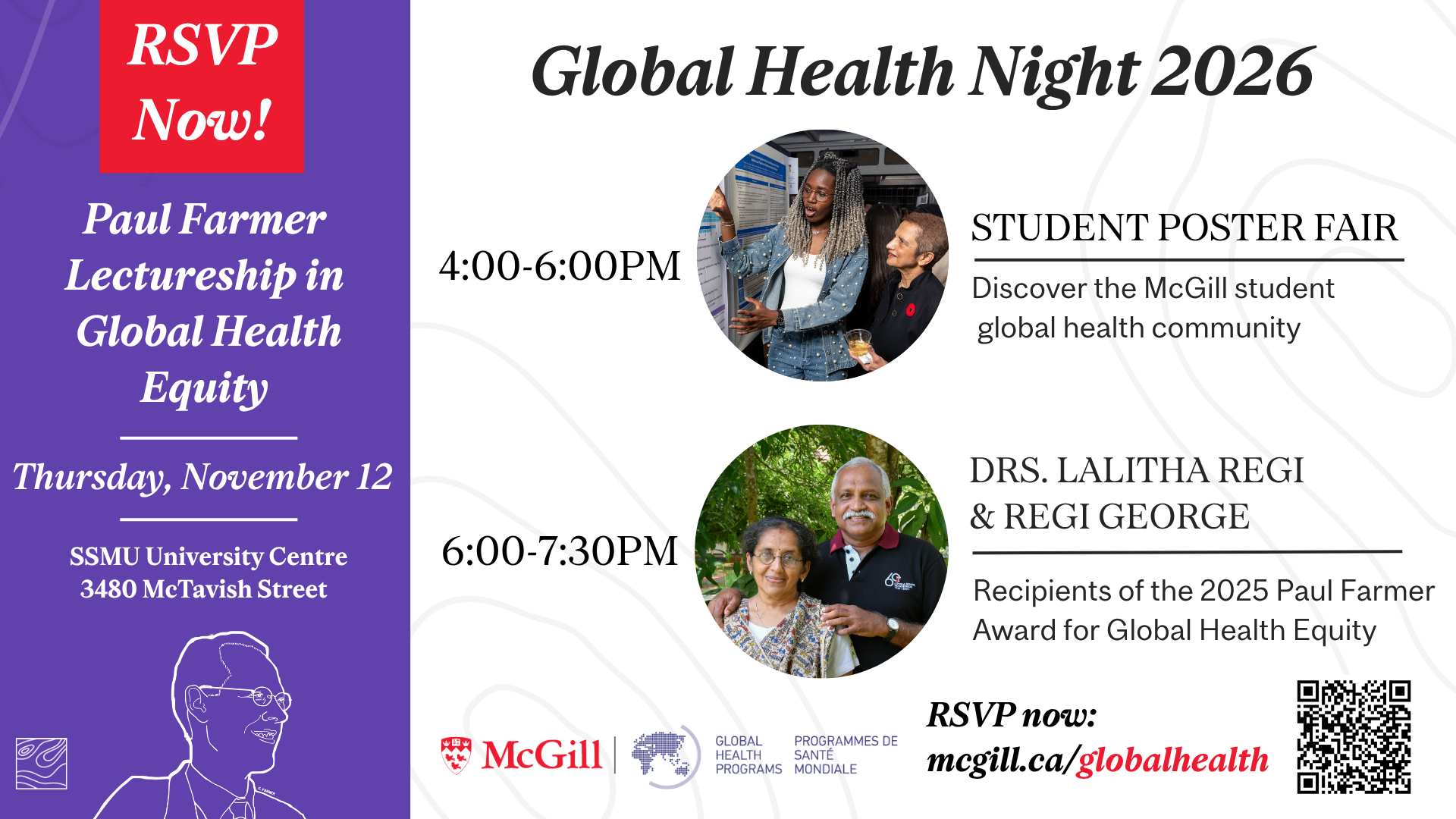
Drs. Lalitha Regi and Regi George will give a lecture in the 18th annual McGill Global Health Night on Thursday, November 12, 2026, from 6:00 PM to 7:30 PM ET (hybrid).
When asked what students should expect from their lecture, Dr. George answered:
“The students can expect [to learn more] about our work. But what we would cherish is genuine curiosity from the students about why we did certain things. […] really like questions like […] why did you do this particular intervention at this time? Or what were your failures? Where did you fail? You know, I think we should, we should cherish those things.”
Ready to ask the difficult questions?
Secure your spot here: https://shorturl.at/5p3QB and join us from 4:00 to 6:00 PM for the in-person student poster presentation.
The event will take place at the Students’ Society of McGill University (SSMU), 3480 McTavish Street. Online attendees will receive an email with the link to join the lecture virtually.
Hosted annually by McGill Global Health Programs, Global Health Night brings together students, faculty, researchers, partners, and members of the wider McGill community to celebrate student achievement and engagement in global health!
Sofia Santos Nunes
Sofia Santos Nunes is a PhD student in Mental Health at McGill University. She holds an MSc in Clinical Psychology from the University of Lisbon and has nearly 10 years of experience managing European Union-funded projects in the field of aging in Portugal, Spain and Belgium. Passionate about Global Aging, Sofia is currently an EPIC-AT Fellow and Editor-in-Chief of this blog. When she is not advocating for the rights of older people, Sofia enjoys reading, hiking and doing picnicking.