
Ebola, Bombs and Migrants: Dr. Joanne Liu Reflects on Humanitarian Action, Solidarity and the Courage to Act
By Sofia Santos Nunes
Author: Alenda Putra
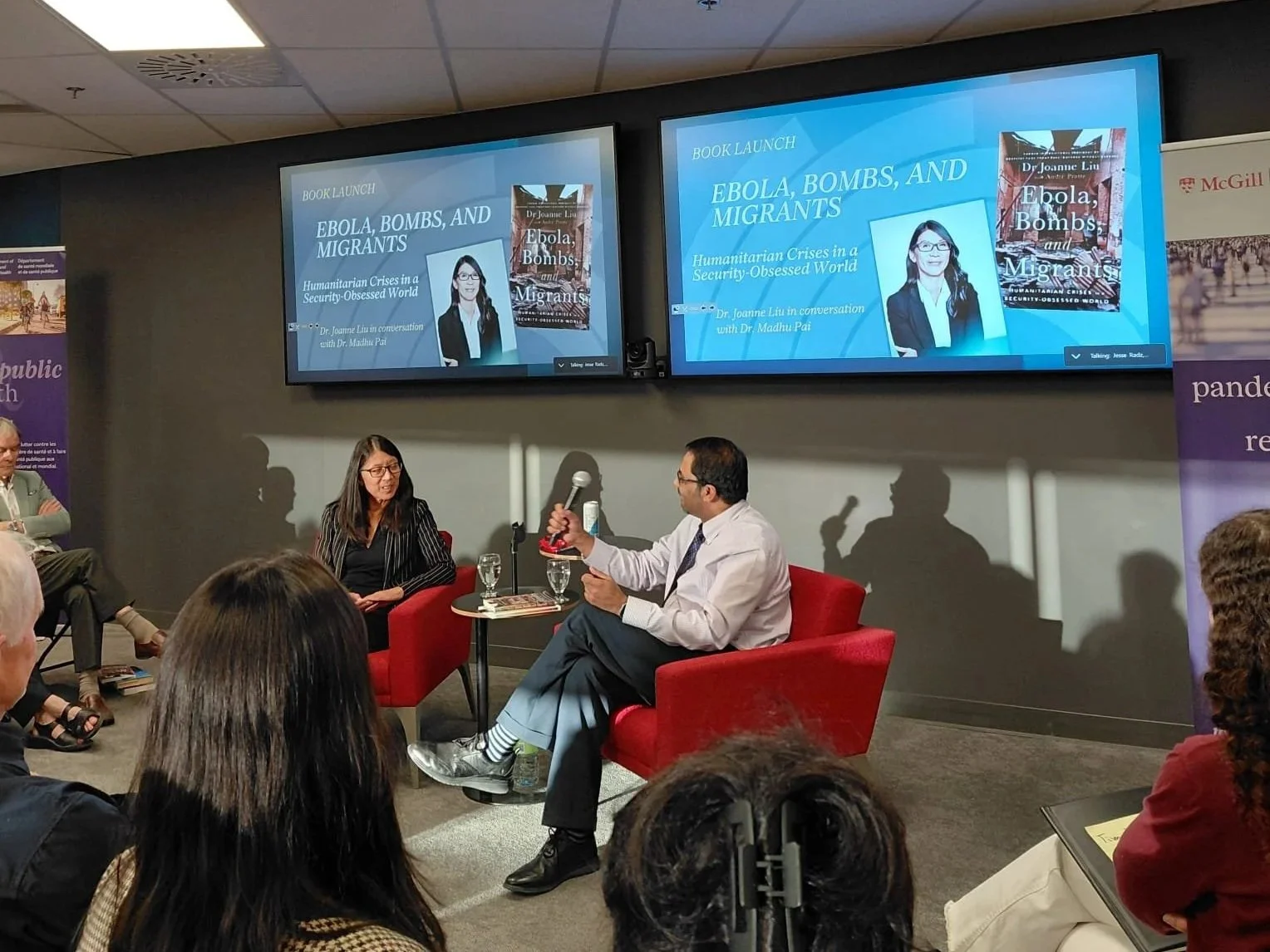
On September 22nd, a sold-out audience gathered at McGill University’s School of Population and Global Health for the launch of the English edition of Ebola, Bombs, and Migrants, the latest book by Dr. Joanne Liu, former Médecins Sans Frontières International President.
Dr. Liu, a McGill Medicine graduate, pediatric emergency physician, Professor at McGill’s School of Population and Global Health and Director of its Pandemic and Emergency Readiness Lab, spent six years as International President of Médecins Sans Frontières (MSF)/Doctors Without Borders.
When people asked her how she would summarize those years, Dr. Liu recalled having a three-word answer: “Ebola, bombs and migrants.”
Those words eventually became the title of her book.
“They are what reshaped the humanitarian aid sector,” Dr. Liu explained during the conversation with Prof. Madhukar Pai. But the book is also built around a broader argument. Dr. Liu described the period following 9/11, 2001, as an “era of fear”—one in which an increasing preoccupation with security has, in her view, progressively weakened mechanisms of international solidarity.
i. Ebola: When a crisis becomes “our” crisis
The first crisis takes readers to the 2014 Ebola epidemic in West Africa.
Dr. Liu recalled that MSF recognized early that the outbreak was behaving differently from previous Ebola epidemics. Transmission chains were appearing hundreds of kilometres apart, suggesting that multiple outbreaks were effectively unfolding simultaneously. MSF repeatedly warned that the world needed to prepare for a worst-case scenario.
For months, Dr. Liu said, those warnings struggled to generate an adequate international response.
The shift came when infected international aid workers were evacuated to the United States. Ebola was no longer perceived as geographically distant.
“All of a sudden, there was Ebola in the States,” Dr. Liu recalled. International attention accelerated.
For Dr. Liu, the episode illustrates one of the central arguments of the book: international solidarity can become conditional on whether wealthy countries perceive a crisis as a threat to themselves.
Eventually, governments and institutions mobilized around the Ebola response. Dr. Liu was invited to brief the United Nations, an unusual role for a humanitarian organization such as MSF, and the epidemic prompted major discussions about the weaknesses of global outbreak preparedness.
Looking back, Dr. Liu sees part of Ebola’s legacy in the systems that later helped scientists respond to COVID-19, including faster sharing of genomic information and greater international coordination around research and development. Where the international community failed during COVID-19, she argued, was not necessarily in scientific cooperation, but in ensuring equitable access to the resulting medical tools.
2. Bombs: When hospitals cease to be safe
The second crisis is Kunduz. In October 2015, the MSF trauma centre in Kunduz, Afghanistan, was repeatedly struck during a U.S. air attack. Dr. Liu recalled that MSF had shared the hospital’s coordinates with the relevant authorities and that the facility was treating patients regardless of political affiliation.
The attack killed patients and MSF staff.
What followed transformed Dr. Liu’s understanding of humanitarian protection.
MSF demanded an independent investigation. Dr. Liu described an organization that was simultaneously mourning, angry and confronting the realization that a hospital—one of the spaces humanitarian workers had believed should remain protected even in war—could itself become a target. The organization subsequently took its case to the United Nations Security Council.
The central message, Dr. Liu recalled, was straightforward: international humanitarian law still applied, civilians had to be protected, and “the doctors of your enemy [are] not your enemy.”
Yet years later, Dr. Liu told the McGill audience that her concerns about the protection of medical facilities have only deepened. She argued that rules protecting hospitals and health workers mean little without accountability after they are violated. Mechanisms may exist, she said, but when investigations and consequences are not enforced, there is little political cost attached to breaking those norms. However, we should not give up, believing that change is possible is precisely what keeps people pushing against systems that appear immovable.
iii. Migrants: When helping becomes controversial
The final strand of the book concerns migration.
During Dr. Liu’s presidency, MSF became involved in search-and-rescue operations in the Mediterranean as people fleeing conflict and hardship attempted dangerous crossings toward Europe. The organization would later work along migration routes in other regions, including Central America.
For Dr. Liu, the migration crisis represented another transformation in humanitarian work: what she described during the event as the “criminalization of aid.” She recalled humanitarian workers and organizations facing growing hostility for assisting migrants, and spoke about visits to detention centres in Libya where migrants were held in conditions that profoundly affected her.
In her book, she writes:
“Migrants are not an indisctint mass. They are individuals, in fact, who, like my parents, are not asking for anything other than the chance to offer safety, education and health care to their children. They left their countries because it was the only choice they had. And once a country welcomes them in a dignified manner, they will be eternally grateful.”
A book about the past—and the present
Although the book chronicles events from Dr. Liu’s years leading MSF, much of the evening was devoted to how those experiences resonate with contemporary global health. The discussion connected her earlier experiences to present concerns surrounding epidemic preparedness, attacks on health care, international humanitarian law, migration and the future of multilateral institutions.
For Dr. Liu, these are not independent crises. They raise a shared question: how much solidarity are societies willing to sustain when fear, security and national interests pull in the opposite direction?
But the evening did not end with despair.
When a student asked how young people could contribute in a world increasingly shaped by polarization, Dr. Liu offered unexpectedly practical advice: talk to people who disagree with you. Remaining exclusively among people who share our assumptions, she argued, reinforces biases and creates blind spots. Instead, she encouraged students to seek what she called les mariages improbables —“unlikely marriages” between people, perspectives and ideas that might otherwise never meet.
“Speak to people that you disagree with,” she told the audience. If possible, she added, “try to do a project with them.”
For Dr. Liu, new solutions are unlikely to emerge from increasingly isolated camps.
As a teenager in Quebec City, Dr. Liu read Albert Camus’ The Plague. What stayed with her was the image of a physician continuing to confront suffering because he had never learned to accept death as ordinary. Dr. Liu remembered making herself a commitment: she would not trivialize death, and she would fight for life.
Decades later, after Ebola treatment centres, bombed hospitals, Mediterranean rescue boats and the corridors of the United Nations, that commitment remains recognizable.
As Dr. Pai did, I will conclude with the same striking paragraph extracted from the conclusion of this important book:
“At twelve, fourteen, or sixteen years old, these young people have lost hope. (…) I would like to convince them that it is better to fight for change than to abdicate, that it is better to find an imperfect solution than no solution at all. (…) One must act, try, get involved. Anything but give up.”
Sofia Santos Nunes
Sofia Santos Nunes is a PhD student in Mental Health at McGill University. She holds an MSc in Clinical Psychology from the University of Lisbon and has nearly 10 years of experience managing European Union-funded projects in the field of aging in Portugal, Spain and Belgium. She has also participated in short-term projects in the United Kingdom, Colombia, and São Tomé and Príncipe. Passionate about Global Aging, Sofia is currently an EPIC-AT Fellow and Editor-in-Chief of McGill Perspectives on Global Health. When she is not advocating for the rights of older people, Sofia enjoys reading, hiking and doing picnicking.